
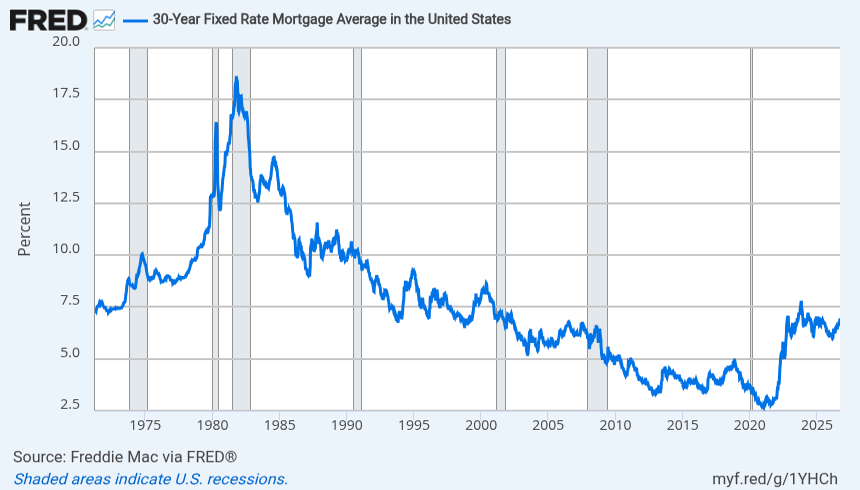
One of the Top 5 FAQ’s today, it’s a pretty easy answer based on today’s economic and political climate. The short answer:
Rates will go down when we have a major change in our economic outlook. So don’t plan on anything changing for the next few months.
Here’s why. As long as inflation is high, and it is, pressure will continue and treasury bonds will remain high. Mortgage rates are specifically based on the 10-Year Treasury Bond. When the bonds are up, and it is at this time (specifically the highest it’s been since 2007), financial institutions add about 2.5% – 2.75% to the bond rate and that’s why we’re at about 6.99%(rate) and 7.172(APR) for 30-Year Fixed Mortgage Rates. If you’re not familiar with APR, that stands for Annual Percentage Rate. It’s the final interest rate you’ll be paying on your loan including all lending fees. Don’t confuse this with Escrow. Escrow includes property taxes and home insurance and other fees. It’s important to know what you’re paying and what it’s for. Enough of all this, “You got a lot of fees and finance charges added to your mortgage payments”. We’ll dive in deeper, so you’ll know when to make a move/change on your mortgage.
Let’s move forward, two of the big influences on our economy is the War on Iran and Tariffs. War on Iran has inflated the price of oil and therefore the price of gas and diesel (yes, jet fuel is in there too). When you think about the food in the market and goods in the store, everything is moved to the stores using fuel. The more expensive the fuel, the higher the price of the food and goods. Tariffs are the other force in prices. Unfortunately, governments levy a tariff or sur-charge and consumers pay the higher prices. Basically, prices on the increase are called inflation. When inflation is rising, lots of things happen and one of them is the Federal Board Reserve (also referred to as the Feds) raise the Federal Funds Rate. That influences many things including the 10-Year Treasury Bond.
So why don’t the Feds reduce the rate? Well they’re responsible for the overall health of the US Economy. It’s a combination of trying to get inflation to stabalize at 2% and keep the unemployment rate down. You maybe asking, how does raising interest rates keep inflation down and unemployment low? That’s a good question…lol.
Presently the unemployment rate is 4.1% (August 2026) which is relatively low, so that’s not the motivating factor. Inflation is gauged by the Consumer Price Index (CPI). Now becareful when talking about CPI because theres a whole enclyclopedia of difference CPI measurements. Looking at U.S. Bureau of Labor Statistics, we’re at about a 4.3% CPI. In easier to understand terms, if you compare prices in August 2026 to August 2025, prices have increased about 4.3%. Keeping in mind the target is 2% stable (that means consistently at about 2% month after month), you can see we have a way to go. The feds determine that it’s time to slow down buying and therefore they raise the Fed Funds Rate. Slowing down buying reduces demand and if supply remains the same, prices usually decline. Well that’s the theory.
So what can we conclude? If the War on Iran stops and oil prices go back down, we should see a decrease/stabalizing in prices. Same with Tariffs, stop the tariffs and we should also see a reduction and stabalization of prices.
When will that happen? Probably when there is a substantial change in leadership in America.
What to watch:
- Consumer Price Index (CPI)
- Unemployment Rate
- Federal Board Reserve
Just google the above and you’ll get the latest updates.
Disclaimer – these economic statements, recaps and predictions are an opinion of the writer. There are many, many varied opinions of the present state of our economy as well as opinions on what it may take to bring us to success. Even the definition of success is a matter of opinion. You should always conduct your own research and draw your own conclusions to base your investment and financial decisions.